

I met my friend Lucie at our favourite café.
We set our dinner for 6 pm. This would give us just enough time to wrap up work and make our way to the café. I saved my appetite, knowing that our meet-ups are always a feeding program.
Usually, when we meet, there’s rarely an agenda. We call it Mother’s Day, not the official one, but our own. A mother’s day out where we let go of all the roles we play. Sometimes we shop and eat, other times we visit the spa or take a walk and drink matcha.
We love the café for its food, and its atmosphere.
Our routine stays the same. We order food first, and when the waiter asks about drinks, we always give the same answer: “We’ll order drinks after food.”
But in our hearts, we know we will always find ourselves ordering pot after pot of masala tea with enough milk.
We sip, pause mid-conversation, ask for our tea to be warmed, sip again, and inevitably order another pot. Tea and conversation are so intertwined in our friendship that someone should turn it into a thesis topic.
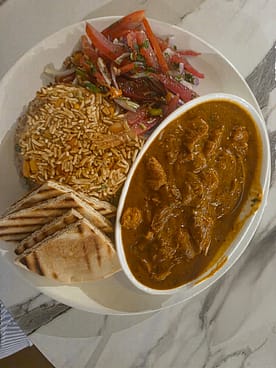
Koroga masala chicken
I ordered koroga masala chicken, and Lucie chose chicken stroganoff. We talked about everything as we ate. Later, we asked for tea.
Between refilling our teapots and the quiet pauses, we spoke about something we both carry- Preeclampsia.
The tea was warmed twice in between our convo. It was not the tea that cooled too quickly, but the way our conversation stretched on, overflowing with memories and emotions.
At one minute, we were tea-ing. Next, we were tearing.
“Mine would have been 13 this year,” I told her quietly. Would he be passionate about football as well?
Lucie nodded as if to say ‘maybe’
“Mine, 10.”
“I didn’t even know what preeclampsia was,” Lucie said.
I smiled faintly.
“Me too. I was told my placenta was detaching – they called it placenta abruption.”
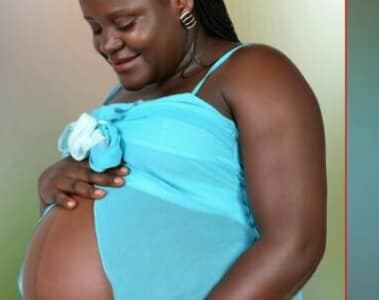
When I first learned I was pregnant, I was in campus and unprepared. But slowly, something inside me began to shift.
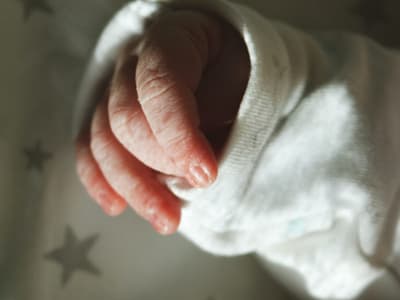
I started to picture my baby. His tiny hands, soft lips, and angelic smile. In the meantime, I called him my little sunshine as we looked for a suitable name.
I did everything right.
I went for my antenatal visits.
I ate well.
I took my supplements.
Even when my blood pressure began to rise, I followed every instruction I was given.
Yet beneath the surface, something was unfolding that I could not see.
Preeclampsia does not always announce itself loudly.
It often slips in quietly.
A headache.
Swelling.
On and off cramp-like pains
A nagging sense that something is off.
Preeclampsia is a high blood pressure disorder that typically develops after 20 weeks of pregnancy. According to the World Health Organization, it affects 3-8% of women who give birth worldwide.
Lucie leaned forward.
“For me, it was headaches. The kind you think will go away after taking gallons of water.”
“And the swelling. I couldn’t fit in any of my shoes.”
One Friday evening, everything changed for me.
Just a day after seeing my gynecologist and being advised to rest, the cramp-like pains recurred. I went back to the doctor the following morning and was told they were normal. I went home.
But the pain clung to me all the way home.
Then I started bleeding.
I remember standing, frozen and stunned, trying to make sense of what I saw. I called my doctor, who urged me to get to the nearest hospital right away.
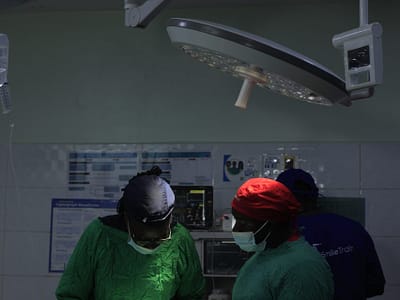
After hours of pain and fear, I was taken into the theatre.
My baby, just past 29 weeks, entered the world in silence.
Lucie reached for my hand.
“I’m so sorry,” she whispered.
I nodded, raised my cup in a silent toast, and took two slow sips—the kind you take with warm sugary porridge, more for comfort than for flavor.
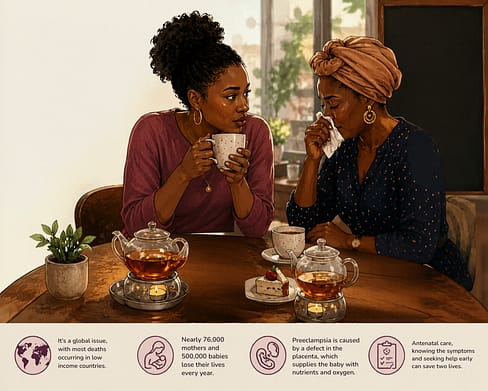
Some grief never truly leaves. You simply learn how to carry it.
Globally, preeclampsia remains a silent crisis.
Every year, nearly 76,000 mothers and 500,000 babies lose their lives to preeclampsia and related conditions. Most of these deaths happen in low-income countries.
“My baby was early too,” Lucie said.
“They said they had to deliver her to save my life. I had already looked for a name. I called her Lerato, meaning loved. When I saw her in the Neonatal Intensive Care Unit, she was so small. So fragile. It was as if she was struggling to breath. I tried to hold on to hope. But deep down, I knew my Lerato might not make it. On the last day, she tried to open her little eyes to look at me. I think she was saying bye”
“That’s the hardest part,” I replied.
We sat quietly for a moment.
Between us sat more than just tea.
There were memories—the sweet, the bitter, and everything in between.
“But I survived,” Lucie said finally.
“And that matters.”
It does, I replied.
Preeclampsia doesn’t just take lives. It leaves behind women who must heal physically, emotionally, and mentally. Women who must make sense of what happened, who must learn to trust their bodies again. Healing takes time, but it is possible.
Lucie and I found our own gentle ways to heal. She sought therapy, while I poured my heart into journaling. Those small acts brought us comfort and understanding. Please don’t walk this path alone.
This year’s World Preeclampsia Day theme is: “Know the Symptoms. Take Action.”
Knowing can save lives.
Knowing that severe swelling is not always normal.
Persistent headaches matter.
That changes in vision, pain under the ribs, and a general feeling of being unwell should never be ignored.
Knowing that antenatal care is not optional.
That every blood pressure check, every urine test, every follow-up matters.
As we took our last sip, Lucie smiled softly.
“We should still get the balloons,” she said.
“Yes,” I replied. “We should.”
Because this story is not only about loss.
It is about what we now know.
What we can say out loud.
What other women need to hear.
If you are pregnant, or know someone who is:
Go to your antenatal appointments.
Check your blood pressure.
Listen to your body.
Ask questions.
Go back if something does not feel right.
As we stood to leave, I realized something.
That evening was not just about preeclampsia.
It was about speaking what so many women carry quietly.
We decided to meet again in June, the same month we both faced preeclampsia. We’ll meet in a park and bring balloons—13 for me and 10 for her.
We will blow our love into the balloons, hold them close for a moment, and then release them into the sky. It will be our gentle way of saying: they may be gone, but they are never forgotten.
What is your reaction?